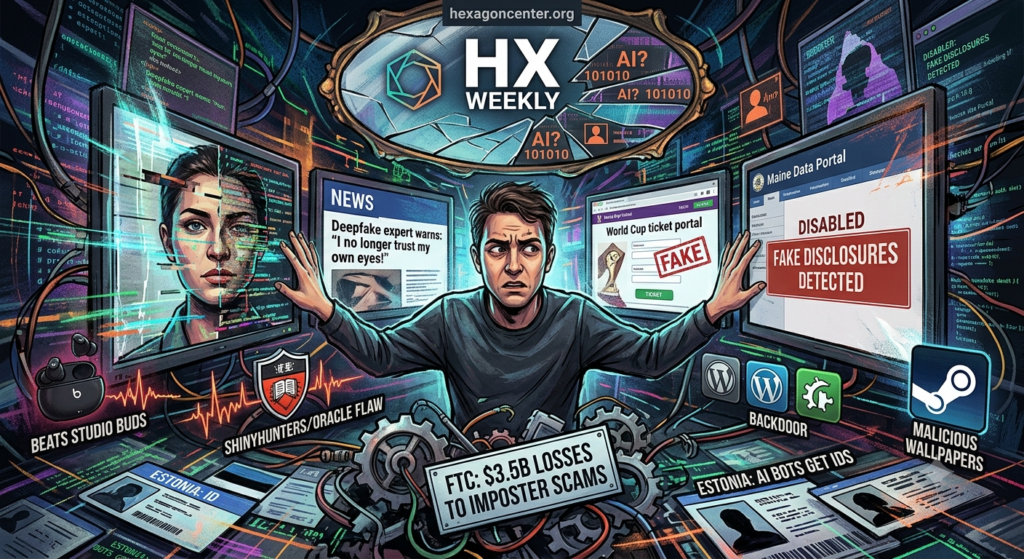

The AI Mirror: Are You Looking at Reality or a Reflection?
Welcome to the 126th edition of HX Weekly. If you feel like we’ve been talking about Artificial Intelligence forever, you aren’t alone. But here’s the reality: we can’t stop talking about it because the landscape is shifting under our feet in real-time.
This week, the line between “helpful tool” and “deceptive trap” has never been blurrier. As AI becomes a staple for both the good guys and the bad guys, we’re seeing a rise in scams so sophisticated that even the experts are starting to doubt their own senses.
The Deepfake Dilemma
The most chilling headline this week isn’t about a massive data breach—it’s about trust. The world’s leading expert on deepfakes has publicly stated that he no longer trusts his own eyes. When the people building the defenses can no longer distinguish reality from a high-quality fabrication, it’s time for the rest of us to adopt a radical new baseline for digital interactions.
- What Now? Verify, verify, verify. If you cannot personally verify the source of a video, an audio clip, or an email, do not share it. Treat every digital interaction as potentially synthetic until proven otherwise.
The Age of Imposter Scams
The FTC has confirmed a staggering $3.5 billion in losses to imposter scams in 2025 alone. This isn’t just about Nigerian princes anymore; it’s about AI-powered voices, deepfake videos of colleagues, and perfectly crafted fake data breach notifications.
- The “Fake” Breach Trap: Maine actually had to disable its data breach notification portal because scammers were using it to send out fake breach disclosures to trigger panic and harvest credentials.
- The Hallucination Cost: Professional services aren’t immune, either. KPMG recently had to pull a major report on AI usage because it was riddled with “hallucinations”—completely fabricated success stories about major global companies that never actually occurred.
Critical Alerts & Security Highlights
Beyond the AI noise, the usual suspects are still hard at work:
- University Extortion: The ShinyHunters hacking group is back, actively extorting universities by exploiting a critical, unpatched flaw in Oracle software.
- Apple Security: A vulnerability in the Beats Studio Buds was patched this week; it could have allowed hackers to eavesdrop on your private conversations.
- WordPress Backdoors: Hackers are currently hijacking popular WordPress plugins to deploy backdoors, turning legitimate sites into silent command centers for their operations.
- Steam Workshop Risks: Gamers, beware. Researchers found dozens of malicious wallpapers in the Steam Workshop that are being used to compromise gaming accounts.
Inside Hexagon: Our Anniversary Buzz
We are in the midst of an electrifying time at the Hexagon Center!
We’ve just launched a brand-new, high-stakes PSA regarding typosquatting—specifically focusing on how scammers are tricking fans into buying “official” World Cup tickets and merchandise from bogus, lookalike websites.
And that’s just the start. We are on a roll, unleashing a fresh PSA every 7 hours on YouTube. We’ve tweaked our production, tightened our schedules, and added a little extra flair to our content. Head over to our channel to catch the latest videos—see if you can guess the theme of each one!
The buzz at the center is real, and we want you to be a part of it. Whether you’re looking to brush up on your own security or want to volunteer to help protect others, join us. Let’s keep each other safe, informed, and—most importantly—verified.
Stay skeptical, stay secure, and have a great weekend.
— The Hexagon Center Team