

Don’t Fund the Fraud: A Week of Spam, Scams, and Cyber Extortion
The 125th edition of HX Weekly serves as a stark reminder that while the tactics evolve, the motive remains the same: your money. Whether it’s high-tech espionage or low-effort extortion, cybercriminals are constantly looking for a payout. This week, we saw a massive surge in spam and scams, proving once again that your best defense is a refusal to participate in their economy.
The Extortionist’s Playbook
The headlines this week have been dominated by groups that are doubling down on intimidation.
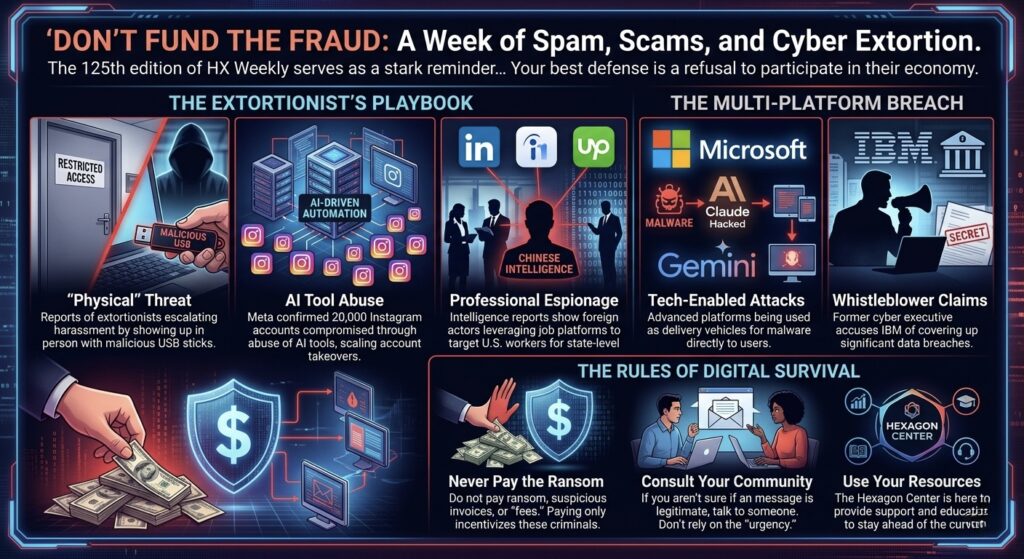
- The “Physical” Threat: We’ve seen reports of extortionists who, when ignored, escalate their harassment by showing up in person with malicious USB sticks.
- AI Tool Abuse: Meta has confirmed that 20,000 Instagram accounts were compromised through the abuse of AI-driven tools, showcasing how automation is scaling up account takeovers.
- Professional Espionage: The threat to your career is growing. Intelligence reports indicate that LinkedIn, Indeed, and Upwork are being actively leveraged by foreign actors—specifically Chinese intelligence—to recruit insiders and target U.S. workers for state-level espionage.
The Multi-Platform Breach
It’s not just your personal accounts at risk—the infrastructure we use for work is under constant siege.
- Microsoft & Major Tech: Microsoft was recently hacked to deliver malware directly to users of AI powerhouses Claude and Gemini, proving that even the most advanced platforms are being used as delivery vehicles for threats.
- The Whistleblower Claims: In a concerning development, a former cyber executive has accused IBM of covering up several significant data breaches.
- The “Hidden” Spam: We are tracking a growing trend where spammers are cleverly hiding their malicious content behind the domain authority of reputable organizations like Google and the New York Times.
What Now? The Rules of Digital Survival
It’s easy to feel overwhelmed by the sheer volume of these attacks, but the solution starts with you.
- Never Pay the Ransom: This applies to everything. Whether it’s an extortion attempt, a suspicious invoice, or a “fee” to regain access to your account—do not pay. Paying only incentivizes these criminals to continue their work.
- Consult Your Community: If you aren’t sure if an email or message is legitimate, talk to someone. Don’t rely on the “urgency” the scammers are trying to project.
- Use Your Resources: You don’t have to navigate these threats alone. The Hexagon Center is here to provide the support and education you need to stay ahead of the curve.
Inside Hexagon: Fighting Together
As we navigate the scam-heavy waters of June 2026, the Hexagon Center is staying the course. Our various programs are currently rolling out across multiple platforms to help you secure your digital life.
Join the Mission: Cybersecurity is a team sport. Whether you want to learn how to better protect your own data or you’re interested in volunteering to help others, there is a place for you here. We learn together, we fight together, and we stay secure together.
Visit hexagoncenter.org to see our latest programs and find out how you can contribute to a safer, more secure digital future.
— The Hexagon Center Team